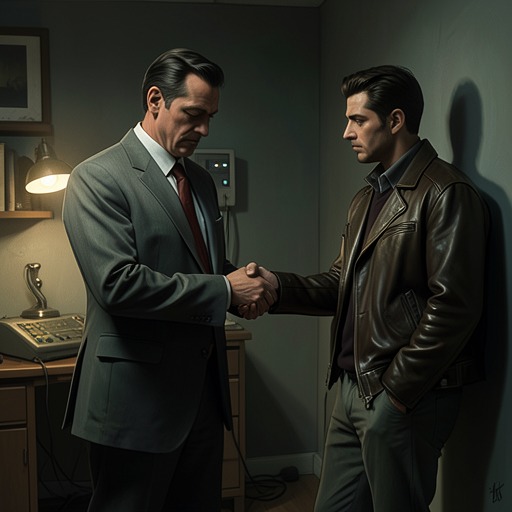
Frank Sheeran—Russell Bufalino
I Heard You Paint HousesFrank Sheeran—Russell Bufalino describes a relationship that joined personal affection to criminal obligation. Russell Bufalino first entered Sheeran’s life as a stranger who stopped to help with a broken-down truck; he later became Sheeran’s mentor, protector, and link to Jimmy Hoffa. Their closeness was publicly legible enough to offer protection and privately consequential enough to draw both men into suspicion after Hoffa vanished. The book’s final image of the pair is not a verdict, but two names in pencil beside a telephone: “Russ & Frank.”
A Roadside Meeting and a Changed Course
In the mid-1950s, perhaps around 1955, Sheeran was hauling meat for Food Fair in a refrigerator truck bound for Syracuse when the engine began to fail near Endicott, New York. At a truck stop, Russell Bufalino approached and offered to help. He had his own tools and worked around the engine, apparently at the carburetor, until it started again. Sheeran spoke some Italian while Russell worked; afterward they shook hands warmly, and Sheeran felt they had taken to one another. He did not yet know who Russell was or expect to see him again.
The encounter acquired a larger meaning only in retrospect. Russell later said he had liked the way Sheeran carried himself. Sheeran, meanwhile, remembered Russell’s confidence, strength, humility, and respectfulness, comparing his reassuring manner to that of a fair priest hearing confession. He described meeting Russell as the biggest event in his life after his marriage and the birth of his daughters. The chance assistance at the truck stop thus became the beginning of a relationship Sheeran understood as life-changing, for better or worse.
Friendship, Introduction, and Reciprocal Favors
Russell introduced Sheeran to Jimmy Hoffa in the 1950s, when Sheeran had three daughters to support and had lost his Food Fair job after stealing meat and chickens to sell to restaurants. He was taking temporary driving work through the Teamsters union hall, teaching ballroom dancing, and working as a bouncer at a Black nightclub. The introduction connected this precarious working life to Hoffa and the International Brotherhood of Teamsters, while Russell remained the person who had opened the door.
Sheeran said he handled matters for Russell on the side, not for money but as a demonstration of respect. He characterized the arrangement as favors rather than hired killing: a person ran an errand, did a favor, and might receive help in return. That distinction conveys how Sheeran described his own place in Russell’s orbit, but it does not make the work harmless. The relationship operated through personal obligation, and the favors tied Sheeran more deeply to the criminal world Russell inhabited.
Russell’s standing gave that bond practical force. He was described as the boss of the Bufalino crime family, headquartered outside New York City but consulted by families across the country. Important matters were entrusted to him; after Albert Anastasia was shot in a barber’s chair, Russell was made acting head of Anastasia’s family until its leadership was settled. Sheeran remembered Russell as a man whose influence was known to organized-crime families and federal officials even though the public had scarcely heard of him. Russell’s reach helps explain why being seen in his company could matter beyond friendship: Sheeran later said that meeting Russell and being seen with him had saved his life in a particular dangerous matter.
Protection and the Weight of Association
One episode shows the protective side of their closeness. After Sheeran made a mistake involving a drive through a neighborhood without checking who controlled it, another man warned him that he had been given one chance and should not make the mistake again. The warning explicitly credited Russell: without Russell’s intervention, Sheeran would have been left to the people whose territory he had crossed. Russell then explained that an ambitious person had resented seeing Sheeran sit, eat, and drink with him and their wives. He told Sheeran to settle the matter immediately and listen to Angelo Bruno. Russell’s friendship could therefore act as a shield, but it also made Sheeran’s association with him visible and politically charged.
That dual effect recurs in Sheeran’s account. Russell offered protection and introductions, yet those same ties placed Sheeran in settings where errands, territory, and perceived ambition could become matters of life and death. Sheeran insisted he was not a hitman for hire; the book nevertheless situates his loyalty within a system of favors and sanctioned power rather than an ordinary friendship detached from criminal business.
Hoffa, Shared Loyalty, and Suspicion
Sheeran described both Russell and Hoffa as close friends, and said the two men were good friends to each other. The bond among the three mattered during Hoffa’s legal ordeals and his conflict with Bobby Kennedy: Sheeran was thought of as family by Hoffa, while Russell had been the one to bring them together. At Sheeran Appreciation Night at the Latin Casino, Russell and Hoffa were both present. Hoffa gave Sheeran a diamond-encircled gold watch; Russell gave him a specially made gold ring, which Sheeran said was intended for only three people: Russell, his underboss, and Sheeran. In old age, Sheeran recalled still wearing both gifts. The objects preserve the intimacy of the relationship in his telling, even as the surrounding history complicates it.
The account also places Russell among those trying to help Hoffa while he was imprisoned at Lewisburg. Hoffa faced strict limits on visits and communication, but could consult numerous lawyers, while messages and business continued to pass between prison and the outside. Sheeran recalled that Russell, along with other allies, was trying to help Hoffa get out. The evidence presents this as part of the larger network surrounding Hoffa, not as proof of any particular action by Russell in the later disappearance.
After Hoffa vanished, the family’s fear was that only someone trusted enough to get close could have harmed a cautious man alert to his enemies. The FBI found a yellow pad Hoffa kept beside his phone, with “Russ & Frank” written in pencil. The book says the two became leading suspects. It also notes that serious studies of the disappearance have alleged Sheeran’s participation in Hoffa’s killing and Russell’s sanction and planning of it. Those allegations make the relationship central to the mystery, but remain allegations in the account; the shared names alone do not establish what happened.
A Bond with No Clean Separation
The relationship’s force lies in the way friendship and criminal association resist separation. Russell’s first act toward Sheeran was practical kindness at a disabled truck; later, his introduction to Hoffa, his protection in a dangerous dispute, and the ring that Sheeran continued to wear gave the bond the shape of personal loyalty. At the same time, Sheeran’s errands for Russell and the pair’s emergence as suspects after Hoffa’s disappearance place that loyalty inside a world where closeness could enable both protection and betrayal. The book leaves the reader with the contradiction concentrated in Hoffa’s handwritten note: two friends joined by a name, and a connection that became inseparable from the unresolved question of what happened to him.